I mean, if you really look at it, we have four iPods. We have two main iPhones. We have two iPads, and we have a few Macs. That’s it. And we argue and debate like crazy about what we’re going to do, because we know that we can only do a few things great. That means not doing a bunch of things that would be really good and really fun.
Last week a friend invited me to see the Helmut Newton exposition at the Grand Palais. It was a huge treat. Above you'll find Frames from the Edge, a documentary about Newton's work.
Newton in many ways defines the photography of fashion: he captured its whimsy, semi-debauched fantasy and fairy tale demeanour. He was utterly unafraid of vulnerability, strength, ugliness or beauty, the blatantly commercial or the grittily banal; you have to be courageous to capture these things, to keep watching until you find them instead of blinking and pretending you didn't see.
His celebrity portraits are also terribly revealing; in one shot he can capture the entire universe of a person, their allure or their insanity or their unexpected forged strength. There is something kind and non judgmental about his camera eye; in front of it, the burlesque becomes a game of dress-up, naked women like little girls in Mummy's enormous fur coat, with shameless parading faces.
Another thing I quite like about Newton is his refusal to buy into this notion of the fashion photograph as art. Bad taste drew him in, and unlike other great photogs, he didn't believe in limiting the number of his prints, in this notion that a picture could lose its soul if it became too present in the world. His imagery is like the fleur de lys: banalised, democratised and ever present, resonating long past the fashions and the times they were meant to represent.
It's a characteristic advertising shares by necessity if not by preference: our work is naturally ephemeral, commercial, the furthest thing from the traditional definition of art. But that doesn't make what we do, what can be done, any less important or beautiful. If we could embrace what he did, maybe we'd find our immortality. Or perhaps the problem of immortality lies in accepting that it doesn't really mean anything, and we have to let that idea go.
A handful of photos I snapped at the exhibition:
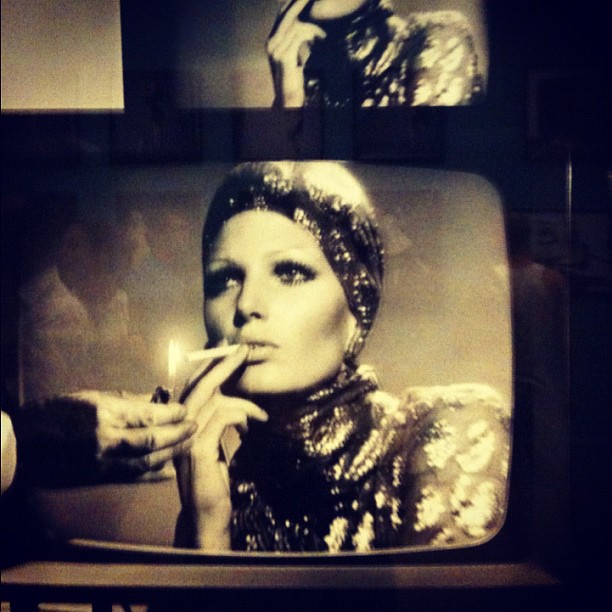
The top photo is of his wife June. I love the intimacy of it, the crass casualness. It's like spying on a naked cowboy. The middle shot is a classic YSL the way I still think of YSL: that woman, untouchable and so pristine that the fact of her existence, the very angles of her body seem to cut through space/time. And that last commercial photograph, with the man who reaches from outside of the screen to light a TV model's cigarette! I love that kind of play, its implications about our ongoing conversation, our own intimacy with media (and its stubborn insistence on protecting its space).
Today on AdVerve, Darryl posted this beautiful video featuring Michael Wolff for Intel Visual Life. I just felt so much better after watching it. It's pleasing to the eye and commands your attention, but in quietly; something in you just gives pause. It's the story of the work that we do and the story of us, as individuals, traveling quietly through our lives.
You'll see here that Wolff emphasises the importance of curiosity, appreciation and imagination -- none of which are possible without really taking the time to see. We know this intuitively but it's harder to live; our inherent desire to be simpler is in constant combat with the world's desire to populate us with itself. I wish I could carry this sensibility with me all the time.
Creatives young and old have had a love/hate relationship with Bob Garfield, who for the last 25 years has produced his "Ad Review" segment on Advertising Age. (His position on this? On a scale of one to five, few ads are total zeros and few ads are prize fives. Over his whole career the average ad has received about a 3.4, significantly higher than the average true quality of industry television advertising output at large.)
Ad bloggers, whether or not they agree with his arguments, arguably see him as the person who began what they continue today. He's also the author of The Chaos Scenario and co-hosts National Public Radio's "On the Media."
I ran into Bob at the Carlton this weekend, then later Monday in front of the Palais, sporting a decidedly cannois summer hat. (I didn't know at the time, but it was also his birthday.) He thoughtfully agreed to sit and talk at a nearby beach side restaurant -- which we only later discovered is probably the loudest atmospheres in all the land.
Read the rest of this nummy num-num on Yahoo! Scene, for which I'm doing Cannes Lions coverage this year.
Some moments after I sat down with SapientNitro’s Worldwide Chief Creative Director Gaston Legorburu and Creative Director John McHale, I got a hard sense of what our time together would be about.
“Our secret weapon is our culture,” Gaston said. And the culture is bred and nourished with conscious attention.
They reflected that they've never actually discussed this with the press before, and maybe because of that, they sat and outlined the entire blueprint.
Read the rest of this (EPIC!) nummy num-num on Yahoo! Scene, for which I'm doing Cannes Lions coverage this year.
The patent-pending WVIL system takes the connectivity and application platform capabilities of today's smart phones and wirelessly connects them with interchangeable full SLR-quality optics. It is the inevitable solution for photographers who expect the power of modern mobile devices but who also demand uncompromised quality.
Technology lives in our service, and sometimes style, performance and old loves can trump convenience. As long as a camera that looks like this, that does what a "proper" camera should do, feels good in our palms, some clever designer someplace is going to try accommodating it, seamlessly linking classic qualities into connected lives.
And of course, around the Internets, there's the inevitable and ironic, "But wait, it doesn't make phone calls...?"
No! And excellent! Because you know what? I am convinced I want this, that I will want to be a better photographer because of it. And that's evidence of something very special: however faster and easier our lives get, some part of us will always want to be an artisan, to learn a craft that can't be Instagrammed for us or smashed into our phones.
This is important. This is part of what makes us human, what makes us grow.
I'm all MIA right now because MIPTV is eating my life, but I've seen so much good stuff in just the last handful of hours that I have to stick them here before I forget.
To start with, with help from James Martin I discovered French air performance band Airnadette last night. Their energy and stage quality is incredible. Plus, it's the kind of art that can only be born in an ever-more-connected world with a shared nostalgia and a passion for mashups. A glimpse of last night's performance at the 314, footage courtesy of our vigilant music bloodhound Stuart Dredge:
They got French people to dance! That basically never happens. And like a spell being broken, shortly after a handful of ever-more-intense encores the crowd awkwardly dispersed, leaving the music hangin'.
This I found on Engadget this morning: a Kinect hack that turns Barcelona tourists into 3D souvenirs - that is, a statue of yourself, posing like a statue, that you can take home! How meta. And also another really good reason to keep up with what's happening in 3D tech dev right now:
A magnificent mashup of art and science, brought to you by blablabLAB, which made use of three Kinects and a RepRap machine.
And lastly - this is just gratuitous - the music video for Jolie Coquine, the first single off the Caravan Palace soundtrack, 2008, via Murielle Cadiou:
I just love the production in this. And that slow, labyrinthine way of revealing a story ... it's compelling.
See Ramon De Leon's full talk at Marketing 2.0 Paris. It is well worth the watch:
Ramon De Leon's Domino's Pizza store is a modern legend - not just in the social space but for the city of Chicago's actual inhabitants. Ordinary people come in just to say hi. They tweet when they drive by. They get excited about meeting THE #RamonWOW (@ramon_deleon) in person.
It's not hard to see why. He's enthusiastic about what he's doing, which catches like crazy. He's also a keen observer of people: how their habits are changing and what motivates them. And he acts quickly to profit from that knowledge: giving shout-outs to his Foursquare mayors, shining the limelight back at anybody who even momentarily casts it onto him. He's a human retroreflector, perpetually ricocheting warmth back at you.
What's more, Ramon records everything: what he sees on the street, cool signage, food. (We had dinner later in the week and he photographed all the entrées.) His own talk at Marketing 2.0 Paris was online an hour after he stepped offstage. I managed to catch him in the process of uploading.
This is one of those ideas that seems incredibly unlikely, unwieldy and volatile. But once execution starts, with the conviction and seriousness that would accompany something infinitely less insane, you find yourself captivated.
How to sell a concert hall? Concert milk! You're like, "...No." I know, right?!
But it works.
The example also shows how we resign ourselves to thinking about our product the way users (or the apathetic) do: classical music makes me sleepy, I can't dance to it, I don't want to listen, there is no place for these sounds in a blue collar space. You're now thinking of the product - in this case, classical music - as mere sound, something that can only please and penetrate the ears.
But it isn't the case. Music is ambiance, experience; in this case it literally (well, supposedly) changes the way milk tastes. Then, in a way, it becomes ingestible. On top of that, you have the packaging: the relic that educates users in an art that once felt remote and inaccessible ... while empowering them to tell and retell this story.
That's a truly transformative way to approach a marketing challenge.
There are few ways to credibly reinvent the logo. (Consider.) But as our perception of what is grows more fluid, I suppose it only makes sense that people are trying to lend the same freedom to logos without compromising what they're supposed to stand for (the fixed aspect of a brand's spirit).
The MIT Media Lab found a really cool way of doing this: the algorithmic logo. It lends just enough fluidity to yield 40,000 different image variations - without losing any of its core qualities. In that way it's the perfect representation of this media space: fixed, but not; consistent, but flexible; unchanging but dynamic by nature.
Using three colors plus black, the algorithmic design features three intersecting spotlights that can be arranged into 40,000 unique shapes and 12 colors. Researchers can individualize the logo for their business stationery yet still link themselves to the Media Lab. The concept is geeky, serendipitous, and a melding of math and design to arrive at a different way of looking at things.
Fitting that the logo now spearheads a brand that hasn't been able to settle on a visual identity for decades.
Work by Brooklyn's own E. Roon Kang and Richard The of The Green Eyl.
Toys are never just toys. (Ask any agency with a foosball table.)
What you're looking at is a fully functioning Antikythera Mechanism, built with LEGO blocks.
The Antikythera Mechanism was built in Greece around 100 BC and is the oldest-known scientific computer. It was recovered from a shipwreck in 1901, but it took over a century to fully understand its purpose. The machine is an astonomical clock that determines the positions of celestial bodies with a precision that can only be described as pristine. In the example above, you'll see that it can predict a solar eclipse in 2024 down to the half-hour.
I'm reminded of a geeky quote from Ghost in the Shell 2: Innocence (highly recommended): "What the body creates is as much an expression of its DNA as the body itself."
"Litany," by Lowe Worldwide for The Independent, launched in 2000 and still makes a nice, melodic watch.
You will occasionally feel provoked. You'll wonder what this is building to, what revolutionary slogan you're about to get sandbagged with ... but the conclusion is simply the product itself, quietly parked on a porch step with a last accompanying "...don't read."
You are moved, but not overworked. You understand.
I can hardly keep up. And I have trouble imagining a time or place when true creative work was rare and had to be passed, intact but tattered, from hand to hand, or only recounted: a treasure whose survival relied on the willingness of a living vessel to carry and spread it with fidelity. Now our art stands alone and often runs, with little motivation on the part of the creator.
So much of the beauty we're making now is just mash-ups and homages, like this (or like this!). These are great to watch because you can see how a message manifests itself to another person, how we can never, none of us, see exactly the same thing behind our eyes, and how the seed of that ingested mass communication grows and mutates into other messages we can't control.
And yet somehow there remains an underlying known aesthetic, a cue or value that we can recognise...
One of the biggest challenges following the Jasmine Revolution was attracting tourism back to Tunisia. It was a challenge that sparked creative efforts of goodwill from entrepreneurs, like Patrick Robin's "1 Billion Ad Pages in Tunisia."
Egypt faces the same problem; no pleasure-seeking tourist likes the sound of structural volatility. But videos like this one, which demonstrates the immense gratitude, depth of heart and diversity that characterises today's Egyptian, may make the country's work easier.
I put this on my scoop.it out of laziness, but afterward I felt that itchy and irritating blogger's "responsibility" to write it up because the topic is so close to me.
In 2009, artist Nina Paley kindly her labour of love (one year in the world, five years in the making), Sita Sings the Blues, under a Creative Commons Attribution-Share Alike License, which basically gives people the freedom to mash up or otherwise play with the content/likenesses as long as they provide appropriate attribution.
My friend Amanda reco'd the video to me recently and I just fell in love with it. To start with, it's a creative piece of work that showcases Paley's versatility as an artist. Plot-wise, it recounts the epic Ramayana in a pithy, freestyle narrative that brings to mind both Mystery Science Theater 3000 (the shadow commentators) andDrunk History (the heroes do what the narrators say, even if the narrators themselves aren't always sure what happened).
All this is quietly interwoven with the tale of Nina's divorce and eventual discovery of the Ramayana. It's not distracting and it fits right in. Also - and this is my favourite part - Sita's woes are given voice with the musical contribution of '20s-era jazz singer Annett Hanshaw. What more, I say, what more can you ask for?*
I often feel like Anna Karina in this scene, particularly at conferences, where the goal is to network for some vague but promising outcome.
To find an opportunity and be able to pounce on it while clutching watery vodka at a homogenised two-hour mixer is indeed a talent, but I'm little interested in "advancing long-term corporate objectives."
I am looking for people willing to answer immense questions with no answers. The responses sound so sure, so right and somehow still so varied: you're apt to marvel at what we think about that we're never invited to say out loud. This is one of my favourite things to do (and probably the reason why no one ever wants to sit with me).
Last week at a couscous restaurant in Paris, a beautiful retired woman told me to believe in destiny, that life never truly becomes fixed or definitive, and that after 30 years of marriage there is usually no love left. Her husband left her for someone he loved when he was 20 years old, and she is happy.
"Are you going to tell your daughters this?" I asked. They're both slightly older than me.
"Of course not." She laughed that cool, distant laugh of untouchable people in very old movies. "It's good to have delusions in youth. And if my husband had never left me, I would never have met my friend Boris." She motioned to the orderly, grinning man across the table. He used to be a professional water skier, and he let me look at all his ski licenses.
Two days ago in Switzerland, another woman told me that the best way to raise your children is not to make sacrifices for them. "Don't neglect them, certainly, but no one is grateful for a martyr, and it isn't right to be one," she said. She and her husband of twenty years raised the twin girls she had with her previous husband.
Asked whether she believes people can be "sure" they've met The One when they've met them, she nodded but doesn't believe there's stock to it. "I was sure of my first husband," she said. "I felt all the things I'd never felt before: the need to love and be loved, to have children. And the moment I was pregnant and we had to make decisions together, I realised I made a terrible mistake. Love takes maturity, and true friendship at its core. We weren't friends."
The current husband is a freelance director, and they travel together to work on projects. Her previous husband found someone else and had another set of twins: boys this time.
And last night over dinner, a thirty-three year-old man with youthful eyes and an azure blue tie leaned in and suggested we may be extraterrestrials, that what we perceive to be reality - this waking life outside our dreams - may not be objective reality at all. I laughed because he hasn't seen Inception yet.
We spent most of the night discussing God and serial killers.
There’s something to be said about distilling a central theme or idea of a film down to it’s core and translating it into a simple, iconic image. It’s a nice exercise that shows just how limitation can breed possibility and eliminate distraction: by setting yourself a series of self-imposed obstructions, your focus becomes more refined, and communication becomes key.
- Brandon Schaeffer
See more of Brandon's movie posters, as well as a few more of his thoughts, at Escape into Life. (Thanks for the tip, Candace!)