Angela Natividad's Live & Uncensored!

Showing posts with label manifesto. Show all posts

10 August 2011

The Gods Are Waiting to Delight in You. Or Something.


Co-opting the powerful poetry of Bukowski, Levi's releases this ad-cum-manifesto in the wake of global strikes and riots. It's apt to see it now, given what's happening in London, but it would have risen more readily to its Grand Youth Anthem! potential if the agency resisted the urge to toss in that kissing-in-the-swimming-pool potshot that all indie ads need to include under penalty of death.

You could have been braver, Levi's. Kids are dying out there, protecting one another, painting their faces, camping out all hours and wielding makeshift torches. This is the one instance in which they didn't need to be depicted as whimsical and romantic; you could have just focused on the strength, gritty unity and insane heedlessness that animates the conviction of youth.

01 March 2011

35MM: The Message, The Medium, The Message

The speed with which awesome stuff is being created, published and shared today is whiplash-inducing, exponential.

35mm from Pascal Monaco on Vimeo.


I can hardly keep up. And I have trouble imagining a time or place when true creative work was rare and had to be passed, intact but tattered, from hand to hand, or only recounted: a treasure whose survival relied on the willingness of a living vessel to carry and spread it with fidelity. Now our art stands alone and often runs, with little motivation on the part of the creator.

So much of the beauty we're making now is just mash-ups and homages, like this (or like this!). These are great to watch because you can see how a message manifests itself to another person, how we can never, none of us, see exactly the same thing behind our eyes, and how the seed of that ingested mass communication grows and mutates into other messages we can't control.

And yet somehow there remains an underlying known aesthetic, a cue or value that we can recognise...

03 February 2011

'The battle for the soul of Egypt isn't over and done with.'


They know, like we all do, that this regime no longer cares to put on a moderate mask. That they have shown their true nature. That Mubarak will never step down, and that he would rather burn Egypt to the ground than even contemplate that possibility.
- "Egypt Right Now," Sandmonkey's first-hand account of what's happened in his country over the last 9 days ... and 30 years.

When you read this, take into account that there's no room left to behave as if human equality is a subjective thing. There is no more space in an increasingly connected world to say that what a tyrant, a tyrannous government or a tyrannous enterprise does with its dependents is its own business.

Faster communications makes territory less important and distances insignificant. That means institutionalised repression and blows to free thinking, to the liberty that sparks innovation, becomes everybody's business. The world is now too small for this.

I'm going to say something cheesy now, but I think it has to be said this way. Technology is where it is today because of higher numbers of ever more ambitious hackers fighting odds, rigid corporate standards, suspected limitations and attempted castrations of the internet's liberty. They are dogged, they self-organise and recognise no authority but the merits of what works, cutting away what doesn't, and we have all advanced because of it.

In this world and tomorrow's, that hacker culture belongs to everyone: people with access to the tools to fight governments, self-organise and speak out against human injustices without having to go through prescribed channels.

The channels that matter now belong to us. Use them wisely, tirelessly and fearlessly. United, able and armed with knowledge, we can make civilisation a kinder, more efficient machine, worthy of its name and richer because of the dynamism that serves one god: freedom. The freedom to think, be educated, feel safe, ask hard questions and decide our destinies.

This is what Egypt, Tunisia, Jordan, Yemen and other countries, newly inflamed, are fighting for now. This is what we should be defending every day, even if we feel like it's not our fight.

It's always our fight.

05 January 2011

'...The Freedom + Flexibility to Think Beyond Coffee.'


That's the money line in this dull but inoffensive video of Howard Schultz explaining Starbucks' logo redesign.

And here's how I'll explain it.

Starbucks isn't about coffee.* It's a spirit and a vibe. (The "third place" philosophy comes to mind - I still find that special in a time when most anywhere can be your third place.) Today it hocks branded merch, boasts a respectable musical catalogue, and even punts books, gum and coffee liqueur.

And however much it contrives to artsy, we know the truth: Starbucks is candy. It's bubblegum pop masquerading as indie rock. And it's good at it. This logo revamp is the perfect example: that aesthetic is clearly the fruit of a time marr marked by digital badge-hoarding - but it's still unassuming enough that it'll slide by in our periphery, recognisable and accessible as-needed.

Starbucks is wise enough to know that the hive mind is volatile. Transparency's become our religion, and it pays us just enough lip service to accommodate the mildly suspicious. Look at this page a second time: it's the work of a corporation self-consciously aligned to a communications sphere dominated by blogs and YouTube. Everybody's on a first-name basis, graphics appear in a neat little side column, the CEO sits for an unpretentious video...

...and it passes. It's not hurting anybody, it's just wearing fresh makeup. The company experiments just enough to maintain the evolutionary equivalent of a brisk walk (it was among the first to collabo with Foursquare, for example).

Nothing about this strategy is sex, drugs and rock n' roll, but it keeps Starbucks palatable to all but die-hard café purists (and that's cool, they have Grumpy and the Grove). It's not heedlessly stumbling into new channels without watching its step and considering the perception of its brand in the context of the given medium. And that may be boring, but it's smart.

A logo design that lends the "flexibility to think beyond coffee" is a euphemism for something that seems small (the removal of "Starbucks Coffee") but is significant: it liberates Starbucks from the shackles of defining itself as a coffee company in words (a flagrant lie with no feasible future).

The market will always have room for that kind of Starbucks: recognisable, innocuous, just modern enough to speak our language without raising eyebrows, bearing wares that please and support the company culture.

That's a thousand-year survival strategy that outlives the ephemeral idea of definition by product.

UPDATE, 7 January: I have to revise my opinion because of a convo with my homie Robert Gorell. Basically I concluded that Starbucks is synonymous with coffee for a lot of people, which makes the removal of the words all the more powerful: it need not be said. But as I mentioned above, it still liberates Starbucks from an uneasy and restricting marriage exclusively to coffee on the balance sheet.

Hit tip, Adfreak.

---

*It did play a leading role in presenting café culture to the American market, but even then it was no caffetteria italiana. It played dress-up, and, captivated, we did too until we got too old. I speculate that this was one factor in the great backlash.

13 September 2009

One Heist Worth an Emmy

Congrats to Psyop and Wieden + Kennedy/Portland for "Heist," their Outstanding Commercial coup:


The brand Coca-Cola was born in 1887, and it's done a stunning job of maintaining fidelity to its good, clean Happy! worldview -- even as the world changes dramatically around it. Check out this piece from 1889:


Worth noting: technology -- and all its advancements -- is your tool. Staying relevant doesn't mean peddling who you are in exchange for every Hype Choo-Choo that comes rambling 'round the hill.

08 May 2009

A Tribute to the Abstract and Aesthetic

What's good about a crappy economy is that advertising takes on a neat evolution. At first you see more direct response stuff -- the result of marketers returning en masse to tactics they know to be sharp and sure, if a little blunt.

Then, as outlook slowly begins to improve, you start seeing well-thought-out pieces that speak to people's now-habitual compulsion to think harder about purchases than they used to. We hark back to discretion, and old tropes about a languid, less obnoxious form of luxury.

That's when you see lovely things like the spots below, which emit a kind of damaged, slightly warped innocence:

"Le Sens Propre" (Goodby, Silverstein & Partners and Blacklist's Cisma for Adobe's "Shortcut to Brilliant" Creative Suite 4 campaign):


"We Need a Change" (for H&M's Matthew Williamson line):


The Schweppes Coquette, featuring Nicole Kidman (I don't like this much, but it helps illustrate the point, sooooo...):


Welcome respite from the primary colours and hard typefaces that accompany the Constructivist style -- another communications approach that blossoms under ad mens' nimble fingers when the market gets dire.

13 March 2009

Assassin

It was Ernest Hemingway who coined the term "grace under pressure." Exhibiting grace under pressure means you don't walk through life in a perpetually defensive stance. Instead you dance, you make it look easy, you smile like a good sport in the face of an enemy. You shake hands.

We don't carry spears anymore and we can't run through forests half-naked, our faces streaked with paint. Our armor now is pinstriped, and our weapons subtle: words, gestures; a raised eyebrow, a slow smile.

Some of us would have been perfectly happy in the jungle, our bodies slicked with sweat as we moved and killed and ripped flesh apart, the heads of enemies swinging haphazardly from our white-knuckled fists. But today is different and one must adapt: we wipe away the blood, the sweat, the war paint, and the stray hair hanging in our faces. We pull on the suit and straighten the lapels. We look in the mirror and practice our clean-slate poker faces, our ready smiles. And we go out into the world and play a survival game as savage as the one we left behind.

But restrict your reflex to kill in heat. Grace under pressure means different steps for the same pastime: it's Assassin, but the guerilla is dead. Nobody's behind the bushes, waiting in the dark for you to approach your threshold. The best assassin is the one you never expect.

The kill is slow; you only know it's happened when you close your eyes.

12 March 2009

Too Many Tasty Things ... and a (Minor) Manifesto.


NASA. Ras Congo. Seu Jorge (the only man alive who can make Bowie sound better). David Byrne. Chuck D. Z-Trip. SHEPARD FAIREY.

More on NASA's music/art renaissance project here. It's exhaustive awesome. See how I have to gush? This is me, gushing.

Slightly off-topic, note how Fairey's become the aesthetic poster-boy du moment -- in part because of two converging trends that stem from the same root (economic decline, American fatigue over Biz-nass As Usual):

Reticent spending and a comically villainous government climate precipitated a return to working-man chic and ironic, tight-jawed Russian kitsch -- something Fairey's been preparing for for years.

The proletariat finally gets its revolution; it just didn't imagine that it would be packaged, licensed, sponsored and used to sell handbags, pop music and the new media-driven democracy. Among other things.

03 March 2009

No A for Effort.


Lib-Arts kids want credit for trying hard.

Life isn't Full House, and if you can't get the job done, it's in no one's interest to rub your back and give you props for spending precious time. Suck it up and -- hey, while you're at it? -- SUCK IT UP.

---

Notes on image: “Four Women Crying” (c.1878). Tintype photograph, via.

08 November 2007

How Many Ads Can Talk You into Eating Chocolate Plastic?

In the press room at ad:tech I met a guy called Frank Nein of OrionsWave, who observed the ad and marketing sectors are falling into turmoil -- spinning uncontrollably into hell, sifting through the din in search of equilibrium in a world gone self-publish and multi-platform.

And I can't stop thinking about Chris Franklin of Big Sky Editorial, who laughed at the idea of a viral ad. "All ads are viral!" he'd said. The point he made was that in order for an ad to succeed, it should be watchable again and again.

How many of our frenetic new manifestos are ideas that have always been there, or at least should have been?

With that, and as a kind of tribute to the future, I give you the Tootsie Roll ad. I couldn't count on my fingers and toes how often in childhood I saw this spot.

What's awesome about it is, most everyone I've met who's roughly my age still knows all the words to the song. We enjoyed watching it then; a lot of us still do.

And in our lifetimes, we ate a hell of a lot of Tootsie Rolls.

15 August 2007

On the Meaning of Occupation

"Should men and women, after all, be defined in any important way by their work? The answer, of course, is yes, otherwise the activities that largely support our lives and consume our time would be unfriendly, foreign, and irrelevant to us.

"Our occupation should not be something we visit like the seashore in summer or a prisoner in a prison, despite the fact that the work may be unpleasant [...] Even if it is like speaking a foreign language we haven't learned, that incapacity itself is totally defining."

-Foreword by William Gass, Stanley Elkin's The Franchiser

23 July 2007

We're Consumers Before Marketers; We're Self-Seekers Before Sympathizers

From Adrants:

After attending the Ypulse conference in San Francisco earlier this week, I've come to realize a few things about teens, tweens and the marketers who want them in their back pocket.

It seems like today's marketers are falling into the same potholes our predecessors did: trying to deconstruct cool, relying too heavily on surveys, and forgetting that before we're marketers, we're consumers.

We've been consumers all our lives. That experience is our biggest trump card.

Another thing we don't realize is that generations of kids, teens and adults also fall for the same potholes their predecessors did. What we need to remember is, no matter what age we are, we all suffer from a bit of age elitism.

Generally speaking, today:

  • Tweens, that precious window between 9 and 12, are probably the only individuals that will ever fully buy into our manufactured teen shit. And that's because they're young and want to be teens so badly, they'll swallow anything that looks remotely teen-like.

The problem is, this age window is small. And with the internet changing the way people consume knowledge, it's only going to get smaller as new generations of tweens get savvier.

  • Teens have always tried to skew slightly older than their actual age. Fifteen-year-old girls don't read Teen; they read Seventeen, Cosmo and even Maxim - mags that skew more closely to college-level demographic, or so they think.The good thing about teens is, generally speaking, they still follow mainstream music and trends.

Just don't overthink your pitch!

  • In a quest to solidify their identities once and for all, college co-eds shed their mainstream media love affairs and start dipping into indie films and music.

But mere love of foreign fare does not a worldly student make. College kids also love - love - their parents' and grandparents' pop music hits. I don't know if this is just an Echo Boomer thing or if it has always been the case.

I think if we can bear in mind that we all share a similar superiority complex (and perhaps that's too strong of a term), maybe it'll help us better address one another. This is something that transcends technology and trends.

17 July 2007

The Medium is (Integral to) the Message


I hit NYC for the first time last weekend. Once I got over the elaborate spiderweb that passes for a subway (definitely a far cry from beloved BART), I fell all over myself.

New York is the living, breathing witness to America's industrialized history, stuffed to overflowing with contradictory messages and too many dreams. And like a splatter in the concrete, every once in awhile you find beauty again.

I'm accosted by ads I've reviewed, come to vivid life. It's like they were lying in wait and have leaped out to confront me, pulsing with energy and so much force. The press releases that tried to contain them simply never had a chance.

Since the awakening, so to speak, I've developed an almost superstitious aversion to PDFs. Generally speaking I don't mind them, but in the strange universe of ad critique I find them deceptive for two reasons:
  1. Marshall McLuhan said the medium is the message. Can you divorce the medium from the message? No. In PDF form, the ad lacks the impact and gravity its creators had in mind.
  2. Press releases, which also come in PDFs, are like cheat-sheets. PR execs and agencies love to wax creative about ad particulars on a release. The problem is, your consumer doesn't get one. He or she has no chance of knowing why you picked that color, or why the giant talking tooth made a great inside joke. Fuck poetic license in a PR; it's supposed to be in your AD! (Have I mentioned I also hate reading them?)
I'd like to gauge the quality of an advertisement in almost the same way an art critic appraises some ancient or contemporary oeuvre.

It needs to be in front of me, larger than life, involved in my world. If it's a billboard, I want to be standing under it with my neck craned as far as it will go, trying to decide if it "pops."


If it's a print ad, I want to encounter it in a magazine or discover it hanging above me one drowsy day on the train. If it's a :30 spot, I want to find it appropriately adorning some TV show while I sit fooling with a Rubik's cube on the couch.


A version of an ad in a
PDF, versus the one you come across on the street, is like the difference between a 20-foot Picasso and a JPEG, or the Louvre's Mona Lisa and a postcard.

You can never learn how your advertising moves a person - provided it does at all - until you can experience it in the intended format, whether it's hundreds of feet above you on a billboard, or posing as a coquettish interactive Flash corner on the digital edition of BusinessWeek.

There's simply no comparison.

22 February 2007

Cryptic Marketing Advice

Emotions are only one part of the equation. If you really want to stick, compel your audience to do research, turn over stones, unearth myths. Make them think about you at night.

17 February 2007

Why I Love Warren Buffett


They say Warren Buffett made his first stock purchase at the age of 11, a small number of Cities Services shares for $37 each. When the price hit $40 he sold, only to see them hit $200 some years later.

This allegedly taught him what it meant to invest for the long term. And not just in companies but in the people behind them, too.

One thing I admire about Warren Buffett's annual shareholders letters is their lengthy tell-all nature. You feel the same intimacy encountered when hearing the precious particulars of a good friend's life. He reflects, makes jokes and considers past decisions. He also takes great pains to explain the underpinnings of his methods.

After describing the past year's goings-on and some recent acquisitions including Business Wire, in his 2005 letter Buffett reflects upon the way Berkshire develops relationships:
Unlike many business buyers, Berkshire has no “exit strategy.” We buy to keep. We do, though, have an entrance strategy, looking for businesses in this country or abroad that meet our six criteria and are available at a price that will produce a reasonable return. If you have a business that fits, give me a call. Like a hopeful teenage girl, I’ll be waiting by the phone.
Berkshire does it for keeps.

Businesses aren't just currency machines. They're functioning entities with a culture and an ethos supported by people.

Two contributing reasons to Buffett's decision to join forces with Business Wire lived in company president Cathy Baron Tamraz's two-page letter to him: “As president of Business Wire, I’d like to introduce you to my company, as I believe it fits the profile of Berkshire Hathaway subsidiary companies as detailed in a recent Wall Street Journal article [...] We run a tight ship and keep unnecessary spending under wraps. No secretaries or management layers here. Yet we’ll invest big dollars to gain a technological advantage and move the business forward.”

A close watch on finances, coupled with the gumption to take educated risks, made strong recommendations. Let's add a third element: Cathy who, upon reading Berkshire's profile, wasted no time in developing what appears to be a straightforward, no-nonsense relationship from the get-go.

As a proponent of sincerity in networking I should first have mentioned how important I think it is to start yourself off right before even trying to develop relationships with others.

A responsible financial plan, where you don't spend what you haven't earned, may seem old-fashioned and conservative. But a chill attitude about credit will ease a young business out of your hands faster than you can lift it off the ground. Each debt you take on is like a blood pact against your business's strength. Is a blood pact something you really want to make at every open opportunity? The way you manage money reflects a lot about your character.

A willingness to look facts in the face, take criticism and scrutinize the raw elements of your enterprise are also critical. Buffett knows his businesses in and out. And as well as he knows the balance sheets, he knows the people running them.

Then there's the people element. You should never discount the partners and employees whose near-term destinies it will be to make your business a great one. Even if you don't know all the details of their kids, you should at least keep eyes and ears open to what they love, why they work with you and how they manage others - particularly your customers.

It's my opinion that these are the characteristics that put an enterprise at Berkshire caliber, bearing in mind it ain't Google. You're not looking to explode in a handful of years, you're building a solid foundation that many people can feel good about standing on, perhaps even after you're gone.

The conclusion to Buffett's 2005 letter includes the following admission:
Charlie [Munger] and I are extraordinarily lucky. We were born in America; had terrific parents who saw that we got good educations; have enjoyed wonderful families and great health; and came equipped with a "business" gene that allows us to prosper in a manner hugely disproportionate to other people who contribute as much or more to our society’s well-being.
It's not everybody who shares Buffett's net worth, or the sense of immense gratefulness and personal responsibility he exhibits to the people who make it possible and society at large. It merits noting.
Moreover, we have long had jobs that we love, in which we are helped every day in countless ways by talented and cheerful associates. No wonder we tapdance to work.
Oh yeah, that last thing. It helps to pursue something you love doing. Be passionate. Please.

17 January 2007

Is There a Reason to Surrender the Foosball Table?


Hot off the heels of Time naming YOU its Man of the Year, Advertising Age crowns The Consumer Agency of the Year. Looks like we've got a new rock star.

You're hot. You're blowing up. Bask in those rays, then record your acceptance speech on YouTube. We won't just listen in total adoration; we'll even take notes.

It's really great that the mistakenly-named Little Guy is finally getting kudos for being an assertive customer who wants to one-up Ad Man and Big Business, but now that consumers are doing all the work, what are advertisers doing?

Handing over their jobs, that's what.

Everybody from the NFL to Dove is conducting send-us-anything consumer ad contests, presenting their "win a :30 spot!" pitches in a way that's stripped itself of any professional or creative guise in order to pander. It's safe to say marketers are responding to the consumer-is-king backlash by fanning the flames, happily handing over the rights to their mini b-ball courts, paycheques and ... jobs.

You've heard me mention before that you can really only be a great marketer if you know (or for those most lofty, remember) what it's like to be a consumer. I stand by that. I also maintain it's not news that the consumer has power - the consumer has always had power. From the beginning of the value dialogue, when mercantilism created scalable variety in the marketplace, people had the power to choose where to spend their money, and to relate feedback about the quality of our products and services to their friends.

Web 2.0 merely enables today's consumer to wield these same powers in a way that finally shakes businesses so significantly they have to listen. And that's good, because these days some businesses can get so big they forget that they have customers to answer to, with specific needs and opinions of their own.

Today a customer doesn't merely vote with financial capital; they can vote in critique, parody and even their own brand of investigative journalism, then reach an audience of thousands of sympathizers. That's incredible.

And now they want to talk to marketers about marketing. In fact, some marketers appear to think they want to take marketing on completely. That's a dangerous line of thought, and it doesn't necessarily yield the best results. Even the NFL's sad plea for consumer-generated ads ultimately ended with an ad guy winning the pie.

Big shocker? No, not really. The best marketers, like the best anything, have fallen in love with their profession. They can listen to the word on the street and engage it proactively without losing their own identities - and the identities of their brands - in the process. That's what makes them the best.

We're creative professionals. We spent years studying demographic trends and trying to wield emotions with one line, one graphic, one life-changing product. It's our job to generate great ideas of our own that engenders feedback and incorporates it in some way. We're trying to have a conversation with a society, not a master/slave dynamic. That turns our brands into faceless entities with OBO written across their logos.

Our customers, the people with whom we should have the most intimate relationship, are finally able to engage us in a two-way dialogue on a more even playing field - that's cause for celebration. But we've still got our own contributions to make to the big picture. We must still create work and generate interactivity in a way that's provocative and well-executed, because that is our job.

Our customers aren't trying to replace us - they've got their own dreams to follow. They're asking us to tell a story we might be missing, one that might add value to the images of the products and services we represent. Marketing needs collaboration between creative professionals and the people they're trying to talk to. Because marketing is, at its lowest common denominator, a conversation about the customer and about the immediate world. It's a running dialogue about us.

Don't trash your responsibility to your brands and society at large, letting whosoever wishes run the circus. We're trying to establish relationships here, not hand over the keys and the pink slip to the livelihoods we love. There's nothing lamer than trying to hold up a one-way conversation.

04 January 2007

More on Networking

A friend recently made a comment about what a dream it would be to get coddled, wined and dined on a company's tab. "It's not even work!" she snorted.

This topic gets a little touchy for me as people my age often make this generalization about the relationship management component of what I do, either in jest or in the spirit of deprecation.

Let me set the record straight.

It takes serious savvy to learn how to manage conversation's ebbs, flows and silences with people you hope to build meaningful relationships with - people you don't simply choose as friends.

That's the critical difference - these people aren't often friends you elected to make. You get together knowing full well you are meeting for a specific reason that has little to do, though perhaps this should change, with how much you like each other. In a few hours' time it is your dear goal to create a bond as intimate and trusting as an old boys' club, careful to keep silences warm and comfortable because if they veer into awkwardness then the liaison is dead.

Meanwhile you make the right jokes and say things that make you seem amply curious but not too pushy, ethical but not too uptight, witty but not scathing, playful and strong-willed all at once or depending, so people feel value not just in knowing you but in standing on your integrity as a ball-player. Finally, and this is going the extra mile, you have to create a setting so intimate they'll divulge critical details you couldn't otherwise learn from the outside.

It's fine work that takes a steady hand. I wrote an article called Ground Rules on Being a Team Player that elaborates on similar delicacies in an office environment.

Dealing with people gracefully and productively takes a demonstrated willingness to learn about them and stand your own ground. Some people, generally the ones most exposed to this type of relationship management work, grow fond of saying all the right things without investing a sense of sincerity in them. It is hard to trust these people with your ideas and your money.

It's easy to blow expense funds drinking with bullshit people, and it's easy to be a bullshit networker who brings nothing sincere to the table. Here's my more elaborated take on real networking. Obviously there's no clear science, because people are mutable and as many parts emotional as rational. But being sincere, warm and tough are running themes in my experiences.

Oh yeah, and the ability to not pick up the goddamn phone during an engagement. I can't think of anything more alienating than getting shut out all of a sudden by a douche who sticks a finger in my face and says "Hold that thought, I have to take this."

You're the face of your company, for crying out loud. Is that how you treat your customers too?

22 December 2006

Moog Plugs Into Sizzles, Pops and Growls

MoogBubbleGum_5in[1].jpg


Moog promotes its synthesizers and other sound products with neat ads that demonstrate a sound quality so real you might actually expect to see an amp wire trailing out of that mean-ass neighborhood dog's jaw. Text reads "Moog synths & effects: Any sound is possible."

Courtesy of VLAN! who has other variations.

For me the ads illustrate an ever-blurrying line between the real and the fantastic, just as we see consumers invading advertisers' Olympus, and just as we watch those confined to the information-strained Mount having to walk earth again, remembering what it is to be on the ground floor. That might be reading too much into it as what I've just described is a theme I see constantly. In any case, props to Moog.

06 December 2006

A 'Harsh Letter' to My Post-Collegiate Peers

In high school I had this one friend. If she ever felt my behaviour or thought process needed intervention, she'd look at me and softly but firmly say, "I'm going to write you a harsh letter." And she would, outlining carefully what she perceived to be my error and how, perhaps, I could correct it. She always concluded with a reminder of how awesome I am as a person in general, like a peppermint at the end of a meal.

Her harsh letters served as handy yardsticks for me. It is always good to get constructive criticism on how you're faring from somebody on the outside, particularly when you'd rather just complain about your sad lot in life and be sympathized-with.

In her honor, this is my take on the harsh letter. It is written, gently but firmly, for my peers.

Yesterday someone sent me an article about how college graduates have a hard time finding the kind of work they want in this economic climate. They're also strapped in mountainous debt and consequently moving back in with their parents. This article pretty much tells the same story.

Say hello to our generation: the self-entitled, the bewildered, the indebted. It comes as a major surprise for some that those diplomas might not have been worth all the blood, sweat and tears. Oh yeah, and money.

Here's my perspective. If you go to college and study aborigine art, then for some odd reason try to land a financial consulting job, you're not going to get jack unless you have work experience in that field or can demonstrate on the fly that you've got savvy in that arena. I don't know how else you expect to go about it in a rational world.

The old adage about how college is about studying what you want really only works in two scenarios:
  • If you're willing to study what you want, which could be totally left of center, with the raw understanding that getting great work isn't about your degree; it's about selling yourself. That's tough and it requires some thought and skill-set development
  • If what you want to study happens to be in line with what you're actually going to get work in. Judging from the stories coming out of the woodwork, apparently this is harder than it sounds
Serious about committing yourself to a profession? Plan your curriculum and start easing the door open before finishing school. Nail an internship. Get to know people on the inside. I don't buy it when people say they can't study and work at the same time. I did it and while I wasn't a fantastic student I still got what I needed out of college.

If you go into sociology, for example, and would like to write a book on social welfare or the effects of culture on society, that's fantastic. But don't come out of the educational incubator wondering why social welfare opps at $65K a pop aren't falling out of the sky back home in suburbia. Take that waitressing job, volunteer at a non-profit (YES! For FREE) and go write your book. There's no shame in that.

Ayn Rand said it best when she noted that wanting something doesn't automatically entitle you. Show the world how much you deserve your heart's desire. Show the world you're willing to do it just to do it, like breathing. Then the money comes.

Just my $0.02. Take it "until your $#i+ starts to make cents" as Jay-Z would say. And yeah, lit-lovers, that's a pun. (English minor over here. Can you tell?)

When all is said and done, we as people change and so do our interests. It's not like we're married to whatever we choose to do right after college. But try to prepare for at least that first gig.

If you've already graduated, be practical and think systematically about how to get where you want to go from here. You can't demand a powerful, high-paying dream gig for no other reason besides an unmanifested belief that you "earned" it over four years bent over books.

This concludes my harsh letter. And because I'm kind, and because you're awesome, here's a bit of optimistic news - just for you.

29 November 2006

On the Freelancer's Union, & a Pretentious "Citizen Marketer" Rant

I think it is more than clear I am aggravated with Blogger of late. No, not of late; I have always been aggravated with Blogger.


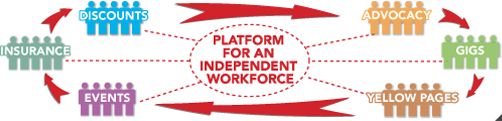
Earlier I wrote an article about the Freelancer's Union (will post or link to it later) and upon reading the stats I was like, great scotts, that's amazing. You're kidding when you say freelancers make up approximately a third of the American workforce. Then again, maybe it's not so hard to believe: "Part-timers piece together a living with multiple jobs, full-time workers supplement their incomes with freelance projects, and others make their entire livings as independent contractors," founder Sara Horowitz explains.

Interestingly enough, with my deeply-involved full-time job and side projects I would never have characterized myself as a freelancer. But maybe it's just my packaging terminology. I like to think of myself as a covert agent or snazzy product juggler or (and this is my personal favourite) straw-into-gold-spinner.

"What about retirement?!" I can hear my pops sputter. (Indeed, it was just the other day.) "What about a good pension!" Come on, dad. I've got higher aspirations than a pension. That's part of what drives anybody's desire to take projects on in addition to one's day job - that and a healthy dose of passion.

Clearly it ain't mom and pops' world anymore.

I don't consider myself a big union person. In my opinion unions outgrew their value once minimum wage became law. But I like the ideas behind Horowitz's atypical customer centric model. Let's face it, freelancers are largely ignored by employers and unions alike in the benefits and advocacy arena. Die-hard freelancers don't get unemployment when they need it, and hell - who needs health perks more than the guy juggling several short-term gigs at once?

I also want to point out that there's no monthly fee associated with membership with the Freelancer's Union; instead you pay for a benefits package (a logical idea! Imagine that), and admittedly they're a little rudimentary, especially health-wise. But hey, reshaping the existing union model for the "New Economy" has to start somewhere. It's not like Horowitz is holding still, either - she created a social networking site for freelancers last summer and is looking to add 401(k) benefits to her cache. Awesome.

The Freelancer's Union was founded in 2001 and already boasts over 37,000 members. It's the 7th-largest union in New York and is headed in the direction of Killa Cali, though the progress is slow-going. Hey, I won't be shy; consider me signed the moment they cross Golden State soil.

All right. I think I'm done evangelizing for the night. But speaking of, here's some interesting reading for your book list. It's all about how consumers are today's It marketers. (Like anybody needed to tell you.) Let me just take this opportunity to point out how incestuous the consumer/marketer relationship is. Screw the old stodgy Ogilvy types (no offense, David O. - I think you're awesome) - you can really only be a great marketer if you know intimately what it is to be a consumer. Embrace the consumer in you the way you'd embrace a bratty, mildly spoiled inner child.

Yes. You hear me. Marketers, your inner consumer is alternately id and innocence. Bow, obey, embrace. Consumers, your inner marketer is that leap in your chest or that sense of complete revulsion generated by a product, brand or company. Roll with those feelings. We're one and the same.