Angela Natividad's Live & Uncensored!

Showing posts with label adrants. Show all posts

15 June 2011

Find Us At Cannes. In PowerPuff Girl Outfits.*


With a little help from Cake Group, Yahoo's launched Yahoo Scene, a magnificent little destination that aspires to give you your industry conference + nightlife fix in the unhappy event that you can't dance on the kegs yourself.

Beginning next week, I join Steve Hall of Adrants and Ask Wappling of Adland in covering the Cannes Lions for Scene. It's going to be entirely too much awesome; what's more, Ask has already promised the whole internet we'll be coming as PowerPuff Girls. (I will be the angry one, Steve will be bubbly blue, and Ask, of course, will be Blossom.)


If you miss our coverage, you will die of sadness. But if long-form bloggage isn't your style, catch our up-to-the-moment tweets on who's where, who won what and desperate cries for attention: @adland @adrants @luckthelady.

Do not miss! Also, for a feel of the ... feel, catch my wrapup from last year, and this reflection on seaside smoking, and this interview with Richard Gorodecky whom I love more than highly productive anthills.

We are so going to rock your ad shit for seven whole days.

---

*Actually, not really unless Ask pushes hard for them.

07 June 2011

Hey Adrants, Long Time No See!


This week, I'll be guest-editing for Adrants while Steve Hall gets his jollies at Internet Week in partnership with Yahoo! Scene.

Finally, a place for all my rage and bile!

Actually, it's not all that ragey and biley -- today is my birthday, and age has softened my gnarly griffon's touch -- but if you miss reading my reviews, tune in. Adrants is still the best place to get your ad fix, be yours shock-factor, gags, tits or beauty. It feels good to be back.

07 May 2008

Before Hanging Yourself with that Apple Extension Cord, Consider the Park Lane

nesquik-happy-place.jpg


I think I'm on suicide watch at Helmsley's Park Lane Hotel.

Somewhere around Madison and 28th St., I contemplated this while absorbing the sight of the NesQuik rabbit, whose gentle invitation to "come to your happy place" seemed to exist just for me.

Everything that happened leading up to Park Lane death watch:

I woke up early today, had breakfast and plugged in my computer. One cannot eat if one does not work; and one cannot work if one does not Twitter.

That's when -- heavens above! -- my trackpad and its clicky button thing stopped working. There was a quiet moment of panic. Then I swallowed what remained of my Belgian waffle, packed my things and hauled ass to the Apple Store.

Some backstory: After attending the OneClub student exhibition last night (to be covered in one of my next posts), I returned to my hotel via subway and noticed with vague interest that I'm right across the street from the Apple Store.

"Neat," I said mildly, even though -- having spent about a quarter of my soul's value on a Macbook Pro last year -- I never planned to walk into an Apple Store again.


"Hmm," said the guy on the other end of the Genius Bar, who blew a little air between the buttons and examined the computer with friendly apathy.* "I'm not really sure what's wrong with it. You're gonna have to turn it in for repairs."

"TURN IT IN!" I exclaimed (ALL CAPS!). "I CAN'T TURN IT IN. I'M ON A DEADLINE!"

He cocked an eyebrow at me. We tried plugging in a mouse; no dice. If I get Pro Care, he said, maybe I can get my computer back in 24 hours.

We stood there while I contemplated the end of my career. I thought of all the news slipping by me, all that typing I'm not doing, and felt myself get all clammy.

"So..." I said. "What if I turn this in and get, like ... a Macbook Air?" For the time being it seemed to be the only solution, plus I kind of wanted to try one anyway.

The suggestion turned the Genius into an veritable faucet of Macbook Air laud. "I love mine!" he gushed. "I bring it everywhere."

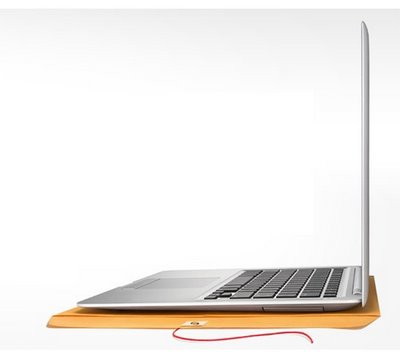
"Do you pack it in an envelope?" I quipped, to which he immediately shouted, "GENIUS! THAT. AD. WAS. GENIUS.

macbook_air_01.jpg


"Every time an envelope is placed anywhere near a computer, there goes more brand recognition for Apple," he bragged. "And you know what else? Now OTHER companies are trying to stuff computers into envelopes. They're all saying, 'Mine fits in an envelope too!' but what they're really saying is, 'I can be just as good as Apple!'

"Apple IS THE STANDARD!" he bellowed.

I thought it might be best to grab a computer and GTFO. So I did. And I tried to be casual about it, but the thought of how much time I was losing (10 minutes until the newsletter deadline!) made me all panicky again. And I hated how, so soon after getting my Macbook Pro, I was once again dropping another two grand on some Apple "necessity."

It was kind of an emotional catastrophe.

On the way home, some other lame stuff happened involving my Verizon wireless card, which I don't really want to get into but which felt really last-straw-on-the-camel's-backish.

I got to the hallway of my hotel when my electronic key card stopped working and then something weird happened: big, deer-sized clown tears started rolling down my cheeks. I felt like a leukemia poster child who'd lost her puppy.

That's when the maid came.

"Oh my," she said. "Oh my."

She dashed over, grabbed my head and buried it in her big maternal bosom, which smelled like carnations and fresh linen.

"Let it out, sweetheart, let it out," she said in thickly accented English. Other guests inched by us, looking awkward.

"He hurt you, didn't he," she crooned, lifting my face toward hers. "You've been hurt."

"Uh-huh," I whimpered, because the actual story seemed too complicated. (In retrospect, senior copywriter Edward Herda observed that I had, in fact, been hurt by a man.)

"You don't cry anymore. You go in and lay down and don't cry," the maid said.

Oddly, the waterworks stopped the second I shut the door behind me. I powered up my swanky new laptop, got to work, and fielded a call from the Park Lane's head of security ("Just checking up!"), as well as a personal visit from the head of housekeeping, both of which gave me their names and numbers and asked me to call if I need "anything, just anything at all."

I later related this story to Diane Stefani of The Rosen Group, which does PR for the One Show Festival. She gave me something between a disturbed and amused look, then introduced me to the OneClub people and other news writers -- two girls that flew in from India and Germany, respectively.

CIMG3007.JPG

We all shook hands and smiled, then I went back to my hotel where I found my room had been cleaned -- again. A small pyramid of chocolate mints sat resting by the bed.

What thoughtful people.

I'm tempted to ask for free wi-fi, but I don't want to seem pushy.

---

* I am actually being really rough on this guy. He spent a lot of time on my issue, trying different tactics and consulting with other Geniuses, and he truly couldn't work out why the trackpad had gotten all late-bloomer on me. I feel grateful, despite that contrasting totally-broke feeling.

28 April 2008

Here We are Now, Entertain Us

One Show wants a little interactive spice in its life.

To help out, Adrants is sending me to the Festival next week. We'll be doing ceremony coverage and afterparty stuff. I am a goo pile of happy.

If you happen to be in Manhattan, we can arrange meet-ups via Twitter. Follow me on Twitter anyway for real-time news and whatnot.

Hope my ad:tech SF cough goes away in time. =\

26 April 2008

Oh No, Oh No, We Pulled the Finger


So Leo Burnett did this objectively lame thing where it released an in-house announcement for its new company dress code. Nothing fancy, typical cog gear: collared shirts and cotton trousers for men, capris or long shorts made of dress pant material for women. Woo-flippin'-hoo.

It's a culture-of-the-industry type of story, so of course the ad bloggers covered it and in some cases tried generating debate over whether agency life merits a dress code. (An office is an office is an office, right?) 

Turns out the story was a (really, really late) April Fools. That's bureaucracy for you!

So here comes AdAge, which is, like, desperate to be in on some kind of Cool Kids inside-track, with this "Leo Burnett Totally PWNS Bloggers" story. It actually goes out of its way to quote the flyer's sauciest bits ("even you creatives!" "Dress for success!" "COTTON TROUSERS AND DRESS SHOES!"*) and then highlights a few blogs that "bought it hook, line and sinker, responding alternately with rage, consternation and even pensiveness."

Yeah, guys. LB really got us, thar. I don't know why anyone would legitimately think an agency might consider putting its beloved creatives in khaks. It's not like anybody's ever released a truly inane in-house memo and expected us all to take it seriously. Or anything.


---
* Emphasis mine.

01 April 2008

On Nixing 'We'

Well THAT was unnecessary. What's wrong with the royal "We", particularly on a multiuser site with an opinionated but like-minded group of people controlling it?
Nothing, in our opinion. We use it all the time. It's neither deceptive nor presumptuous -- rather, in your case, it's entirely accurate. We regret your decision and mourn our loss...
Steve and I decided to stop using the royal "We!" on Adrants. That quotation is one of the comments we received following the announcement.

I guess I should explain this whole "we" thing. When a one-man news publication wants to  sound like he's got untold legions of corporate suits behind him, he uses statements like "we decided" and "we think" instead of the singular.

"We" has serious mojo. It's my impression "we" can do any or all of these things:
  • Put gallons of weight behind otherwise-worthless subjective claims
  • Minimize the necessity of having to do research, because one* assumes a committee of people is better informed than just a single dude
  • Make your organization seem bigger than it is
  • Give articles a uniform tone. (When multiple writers on one website use "we," it lends a sense of harmony)
It might just be my imagination, but I think nixing "we" will force me to be more accountable for what I say under my own name. That'll be a challenge, but a useful one.

On the other hand, I worry that emphasizing individual personalities will exchange a once-unified choir (a "voice of the brand," if you will) for a stage of divas -- the sensation that multiple people are vying for the attention of one reader. 

Which is why I posted that comment at the top. I'm nervous about letting go of this security blanket.

Well, nothing for it but to try.

-----
*Also a great cloaker.

20 March 2008

One Reason Why Men Always Leave Me

So me and Benj are having "us" time in the living room, which means he's sitting in a red armchair doing guitar scales and I'm Adranting on the couch across the way.

Benj stops playing. He looks up and goes, "Listen to this scale. Does it sound like a legitimate guitar lesson?"

"Sure," I say.

"It's hard. These are so basic. I can hardly do them anymore."

"Always good to go back to basics." (I am scanning a press release for agency info. I am wondering why Dentsu is so twisted. I am debating if I should cross-reference goatse. You can never have enough goatse.)

"You know ... my technique was never quite right. I could never play like Paco."

"Practice makes..." I start to say, but then he interrupts by doing something unexpected.

I look up and he's WALKING TOWARD ME. With his guitar.

"I want to show you what I mean," he persists. "What are you doing?"

"Nothing. Well ... working. But I'm listening."

He kneels down and starts to strum. I can't help it -- I cast a fast split-second glance back at my screen and he catches me in action.

"You're not paying attention. What are you doing?" He leans in. "What IS that?"

Long pause. Nothing for it but to explain.

"I'm screenshotting rhino shit."

He doesn't even ask why. Instead he gives me an elongated I-hate-what-you-do-for-a-living stare and goes back to his big red chair.

31 January 2008

Time for Super Bowl 2008

Ad-spotting this year? Dive in prepared. See the Adrants Primer and our stockpile of pre-Super Bowl Sunday notes. (Don't hate -- MoMa sells books of doodles. And I buy them.)

Catch you on Super Bowl Sunday. As of 10pm last night, which is when I finished the requisite team googling, I quietly changed allegiances from the Giants to the Patriots.

It's bitchy. I know.

12 December 2007

Adrants Hits Top of the AdAge Power 150


Back on top. Now, excuse me while I dance around the room in my underpants. (Thanks Bill for telling us.)

09 November 2007

Get Down with the Homies with the ad:tech NY Ad-Jive Dictionary


You can't call yourself a new media advertiser if you're not hip to the jive, and ad:tech is a great place to brush up on this crucial skill-set.

But it can be tough to keep up. With that, I give you the 2007 edition of the Official ad:tech New York Ad-Jive Dictionary. Use this knowledge well, and you're sure to be the life of the break room.

Better still, you'll confirm your CEO's conviction that burning $5K to send you to an ad conference was a very intelligent idea.

Agnostic. adj. Connotation: positive. Used in reference to an application that plays nicely on any OS or browser, or in reference to a marketing campaign theme flexible enough to perform on any media platform. The Hulu video player is browser agnostic, and thank heavens, because I will kill somebody if I have to download IE7.

Ajax. n. Connotation: positive. An acronym that stands for Asynchronous JavaScript and XML, "Ajax" is now a parlor term for a site that updates content without a user having to "refresh" the page. If we add Ajax to the site, our pageviews will get all screwed up!

It can also be used as a verb, allowing for some mental play between Ajax as it is referred to here, and Ajax the household cleaning product. We need to Ajax the forums. Nobody's going to stick around if they have to refresh during a burn war.

CGA. n. "Consumer-generated advertising." See CGM.

CGM. n. Connotation: hysterical, particularly at ad:tech. "Consumer-generated marketing." Refers to "amateurs" (read: non-advertisers) building brand messages, for subversive, evangelical or monetary reasons. Dude, forget about hiring the agency. Why don't we just launch a CGM contest and give away an iPod? I think my cousin has a camera at home.

Collaboration. n. Connotation: euphemistic. The dreamy thing vendors say will happen between marketers and consumers, or between IT and upper management, when their "online solution" includes a messaging feature, a Twitter function or a news feed. State-of-the-art digital technology encourages seamless real-time collaboration between the enterprise and the end user.

Dovetail. v. Connotation: euphemistic. Used when small companies get absorbed or otherwise hopelessly eclipsed by a larger entity. Paths between Wee Guppie, LLC and Big-Ass Sharks, Conglomerated began to dovetail in '03; a collaboration was the next logical step.

Iconistan. n. Connotation: negative. Coined by Sphere CEO Tony Conrad, it refers to the untidy collection of icons, usually found at the bottom of a blog post or article, that enable readers to disseminate the post on a social news medium like Digg or Newsvine.

We see less of this clutter now because social news leaders, such as Digg and Reddit, have emerged in the field. As a result, "Iconistan" has fallen into antiquity -- which is too bad, because it was strangely charming. Dude, your blog looks like a virtual Iconistan. Why don't you delete all that crap? Nobody ever Diggs you anyway.

Intermediate marketers. n. Connotation: nebulous - probably negative. Hails from the dust jacket of a marketing strategy book called The Eyes Have It: How to Market in an Age of Divergent Consumers, Media Chaos and Advertising Anarchy.

The precise meaning of the label remains unclear. Based on its original context, where it was paired with a less nebulous demo, "Advanced digital marketers in the C-level suite," we can assume it is at least slightly pejorative. That shit looks like Crayon on cardboard. Clearly it was disseminated by an intermediate marketer.

Meatball sundae. n. Connotation: negative, but using the expression will reflect positively on the user because it is still fresh. Coined by Seth Godin for his heavily-promoted publication of the same name. Refers to what happens when you put together two great ideas (like meatballs and ice cream) that produce something unfortunate. Rich media ads on a widget? I don't know, Rick. We don't want a meatball sundae on our hands.

The expression may unseat last year's book-title-cum-buzzword, "the tipping point."

New media. n. Connotation: positive. Refers to any number of the socially "democratizing" applications or services -- usually ad-supported or AJAX-heavy -- that have appeared on old media (the online and mobile platforms) over the last several years, bringing said media back into vogue.

Platform. n. Connotation: neutral. May refer to the means by which content is delivered (e.g. the mobile platform), the technology on which applications are built (Google's open source mobile platform), or any other foundation -- figurative or literal -- upon which something else can be built. The platform of Lisa's sanity was piled high with new jargon.

In the tech realm, "solution" and "offering" can be used interchangeably with "platform" when referring to a new means by which advertising or other content can be conveyed. Jerry thinks Facebook's Social Ads solution is the ultimate collaborative platform for advertisers and consumers.

Social advertising, Social seeding, user marketing. n. Connotation: positive or used in jest, depending on who you're talking to (a client versus a colleague, respectively). Refers to astroturf WOM: When advertisers and marketers attempt to harness word of mouth as an ad campaign in and of itself. Attempts to generate inorganic WOM have very rarely worked, and backlash can be uncomfortable. Jesus created a resonant dialogue after implementing an aggressive social seeding approach.

UGC. n. "User-generated content." See CGA.

UGR. n. "User-generated revolution." See UGC.

Viral. adj. Connotation: positive. Refers to when an effort, usually online video-based, gets passed from user to user until the offering becomes part of a larger cultural discourse.

A unit cannot "go viral" until after this has occurred. Marketers that call freshly-released efforts "viral" commit a serious faux-pas in this regard. Did you see that Hitler viral where he's all pissed-off about his Xbox gaming score? You have to. I'll send it to you.

Wikinomicon (not to be confused with HP Lovecraft's The Necronomicon). n. Connotation: expected to weigh in as "positive" when more people know what it means. Refers to the mindset that new communications technologies are democratizing the creation of value. I'm just here to brush up on my intermediate understanding of the wikinomicon. What? You haven't heard of it? Here, take my card.

The working affluent. n. Connotation: neutral. Refers to members of the labor force bearing a net worth between one million and 9.9 million dollars. It is unclear why there is a cap. One may surmise that if you still come to work after breaching the $10 million mark, you likely suffer from Marie Antoinette syndrome -- which, while admirable to the subject, is loathsome to observers. It has not been determined what percentage of Nalts watchers consist of the working affluent, but a fair estimate is anywhere between five and 90.

03 October 2007

Advertising Week: Getting Behind Big Ads with the Editors

Mainly for personal conceits, Advertising Week's Why Editors Matter panel was by far our favourite.

The panel consisted of Chris Franklin, Big Sky Editorial, NY; Paul Gowan, Rogue Editorial, Toronto; and Neil Gust, Outside Editorial, NY. Check out the link to the panel information to see the work they've done; notably, Paul Gowan is known for having edited that Dove Evolution piece that people keep subjecting us to.

Each of adland's Geoff Emerick's had an opportunity to speak, which we'll go ahead and synopsize here:

Paul Gowan

At the outset, Gowan observed that you "just can't get enough of" any of the three spots for which these editors are particularly known. And he's right. A resilient, infectious piece isn't just prerequisite of great art; it's critical to an ad's success (for, um, obvious reasons).

If you can't watch them over and over, what makes you think you're going to push product?

Onto Dove Evolution. Contrary to rumors we've heard, the girl's metamorphosis took three hours - not 10. To address still other rumors, the agency did a making-of video to, we suppose, distill the finehanded work implicit in whittling down a long process in a way that still captures a watcher's attention.

"It does get tiring," Gowan admitted of both editing an hours-long tape and watching it.

And while Dove Evolution seeks primarily to cut into the deception inherent to advertising, it's not without its own smoke and mirrors. The model used in the film was chosen specifically for her relatability to "average" women.

And that Photoshop-esque series of functions at the end, where a mouse widens her eyes and lengthens her neck? Complete invention. If shit were that easy, there'd be no excuse for Condy Rice to look the way she does half the time.

All told, the spot took a whoppin' three weeks and 15-17 hours.

Neil Gust

Gust has got to be the most touchy-feely of his cohorts in terms of talking editing. His work seems to be less about smoothing technical rough-edges than taking unrelated snippets to convey a feeling, a non-narrative that flows like it tells a story.

The object, Gust explains, is to capture a chemistry associated with feelings that clients hope to associate with their product - like "sexy" or "gorgeous."

"They tell me how they want it to feel," he says, and his job is to create relationships from shot to shot that best convey that sensation. Good shortcuts include building formal relationships between themes that leap from cut to cut: streaky imagery throughout, consistent shapes and logical flow.

In the case of the Jaguar ad, the client wanted a "really long car shot," which didn't quite fit into the existing "hyperkinetic visual." To make it work, they stuck in a scene where the car skids to an abrupt stop, the music halts, and an airport voice is dubbed over the long shot of the vehicle. Then the pace speeds up again.

Chris Franklin

Franklin probably reminds us the most of the electives professor with promise that we all encountered in high school. He compares showing off an editor's back-end work to airing your underpants for all the public to see - it's clearly uncomfortable for him, but there's a tinge of exhibitionist pride at the same time.

He calls editing a series of mistakes that work eventually; mainly, it's a painfully solitary and long process.

"You just try to find variations that keep you going, keep you thinking," he says. Sometimes you have to go off and stare at a wall, or buy a flower, just to keep the ideas flowing.

The Ellen spot for American Express consisted of seven hours of footage, and the actress was never shot in the same room as the animals. In fact, each animal in the boardroom scene was shot one at a time.

90 percent of the spot was composite-driven, and each animal (and actress') performance had to be elegantly orchestrated to appear like they were all moving together.

A particular point of pride is the moment in which Ellen and an ostrich nod downward (um, toward a kangaroo) at the same time.

Franklin also scoffs at the notion of a "viral ad."

"All advertising is viral, period," he says. "Any advertising is viral." When you really think about it, that makes sense.

As a final thought, Franklin admonishes editors-to-be against attending the shoots that produce the images you'll work with. "AVOID the shoot at all costs!" - the politics behind the cuts will always affect your unadulterated view of the final footage, and that's a shot in the foot.

Overall, editing is described as as much emotive and sensory as it is logical. And music, dubbed "spiritual glue" by Franklin, is a big factor for casting the feel of a spot. The audience can't be expected to see what you're seeing if you don't provide them with the right background noise.

The Ellen/American Express ad has a distinctive Dick Van Dyke feel that hits you the moment you start watching it, and you're not even really sure why. It's cast in black and white, and the vintage music was produced to give it a "timeless" quality. This early sensation is part of the bouquet of emotions you're intended to feel over the life of an ad.

One of the editors observed that without an appropriate soundtrack, this stuff just doesn't work - and it's all too easy to aim for a popular pop song, because those types of tracks can make nearly any series of images likable, which can lead to lazy editing.

In fact, Gowan calls the use of popular music "Irresponsible [...] unless you're Microsoft." It's considered part of the job to stockpile obscure, interesting and affordable music.

Thankfully, indy artists will meet you halfway in this regard. Now, plenty of records get "made" on the strength of an ad. (Consider the popularity of Telepopmusik's "Breathe" after Mitsubishi eased it into that one ad where that raver dude is dancing around in the car.)

At this point in the game, Franklin notes that great ads can leverage equally good -- but otherwise obscure -- indy work "because RADIO SUCKS, but that's a different story."

So much for Emerick.

27 September 2007

How to Leverage a Hostel Stay During a Business Trip

When this entry was posted on Adrants, Steve saw fit to give it a preamble. I'm just mentioning it (yeah, preluding the prelude) so you don't wonder why I'm referring to myself in the third-person - in italics, no less.

Believe it our not, everyone that writes for Adrants does not, contrary to popular belief, live in New York. So revel, herewith, in the story of Angela as she masters the art of traveling on an Adrants budget as opposed to an Advertising Age budget which, for Adrants readers, is a very good thing.

After all, do you want the highly-edited, overly-tame version of Advertising Week - or do you want the gritty reality of life in the big city as seen by someone like you: People without huge expense budgets who go from glitzy hotel to cab to advertising conference and back again without reveling in everything New York has to offer? Read on
.

You never know when you'll need the skills necessary to support your survival (and cool factor) if you happen to find yourself at a youth hostel during Advertising Week on a (trendy) Bohemian budget. And after three days doing it, I'm a PhD. Read on to glean the fruits of my loving labors:

1. Buy a map. This serves two purposes: locating all the 1 Line stations in Manhattan, and all the shot-in-the-dark buildings the Advertising Week people chose for the seminars (couldn't one location have done the job?).

If colleagues ask why you never take a cab home, say nonchalantly that you know the Subway like the veins on the back of your writing hand. They'll be impressed. Or at least they'll look like they are.

2. Debate, fairly seriously, the merits of leaving the hostel in one set of clothes and changing into another at the conference. You feel like an jerk frequenting a hostel in your working pinstripe. It's probably the only time in your life you'll feel excruciating lust for a pair of flip-flops and a wife beater. Besides college.

3. Actually pretend to be a starry-eyed tourist when hostel-mates catch you taking pictures of ads or bringing home Anheuser-Busch paraphernalia. The problem with hostels is all your neighbors want to talk to you. What are you going to do, ignore them? That's not an option when you share living quarters or a loo.

4. Invent a reason (besides Advertising Week) for being there. Being an ad guy - even a blogging ad guy - is not exactly sexy amongst youth traveling-kind, particularly if they're from Socialist countries or still in college.

People usually invent a reason for you, so this isn't such a big deal: "You're on vacation? How nice." Yeah, if by vacation you mean distilling the social importance of the Green Giant.

5. If you smoke, carry both rolled cigarettes and ready-mades. You'll look trendier if you roll cigs at a youth hostel, but you'll look like a fringe pot dealer if you carry the habit back to Advertising Week. (Be extra cool: bring Parliaments* to the ad parties. This shows you're fringey in a "cultured" way.)

6. Consider foregoing the extra suit in your luggage for spare towels (trust me).

7. Get up at six. This provides you with two-for-one perks: you'll awe colleagues with your fresh-faced early appearances, and you beat your hostelmates to the shower. The early bird doesn't just get the worm; it gets the hot water too.

It's worth noting that staying at a youth hostel has plenty of merits, besides the fact that you'll save $700/night that probably would have gone to a Doubletree. The bonuses are listed below:
  • They sometimes have $1 beers.
  • They enable you to slip out of working-mode once you've left the frenetic world of Advertising Week and Times Square.
  • They have wall clocks that tell the time all over the world. I cannot describe the social dividends you rack up when you're able to recount, off the top of your head, what time it is in London for the homesick Saatchi & Saatchi guy. You will look like a genius.
---

*I'm actually a little confused about the significance of Parliaments as a trendy social tool, but from experience I know its power can't be denied. My best guess is that it vaguely associates the user with being Soviet.

23 July 2007

We're Consumers Before Marketers; We're Self-Seekers Before Sympathizers

From Adrants:

After attending the Ypulse conference in San Francisco earlier this week, I've come to realize a few things about teens, tweens and the marketers who want them in their back pocket.

It seems like today's marketers are falling into the same potholes our predecessors did: trying to deconstruct cool, relying too heavily on surveys, and forgetting that before we're marketers, we're consumers.

We've been consumers all our lives. That experience is our biggest trump card.

Another thing we don't realize is that generations of kids, teens and adults also fall for the same potholes their predecessors did. What we need to remember is, no matter what age we are, we all suffer from a bit of age elitism.

Generally speaking, today:

  • Tweens, that precious window between 9 and 12, are probably the only individuals that will ever fully buy into our manufactured teen shit. And that's because they're young and want to be teens so badly, they'll swallow anything that looks remotely teen-like.

The problem is, this age window is small. And with the internet changing the way people consume knowledge, it's only going to get smaller as new generations of tweens get savvier.

  • Teens have always tried to skew slightly older than their actual age. Fifteen-year-old girls don't read Teen; they read Seventeen, Cosmo and even Maxim - mags that skew more closely to college-level demographic, or so they think.The good thing about teens is, generally speaking, they still follow mainstream music and trends.

Just don't overthink your pitch!

  • In a quest to solidify their identities once and for all, college co-eds shed their mainstream media love affairs and start dipping into indie films and music.

But mere love of foreign fare does not a worldly student make. College kids also love - love - their parents' and grandparents' pop music hits. I don't know if this is just an Echo Boomer thing or if it has always been the case.

I think if we can bear in mind that we all share a similar superiority complex (and perhaps that's too strong of a term), maybe it'll help us better address one another. This is something that transcends technology and trends.

17 July 2007

The Medium is (Integral to) the Message


I hit NYC for the first time last weekend. Once I got over the elaborate spiderweb that passes for a subway (definitely a far cry from beloved BART), I fell all over myself.

New York is the living, breathing witness to America's industrialized history, stuffed to overflowing with contradictory messages and too many dreams. And like a splatter in the concrete, every once in awhile you find beauty again.

I'm accosted by ads I've reviewed, come to vivid life. It's like they were lying in wait and have leaped out to confront me, pulsing with energy and so much force. The press releases that tried to contain them simply never had a chance.

Since the awakening, so to speak, I've developed an almost superstitious aversion to PDFs. Generally speaking I don't mind them, but in the strange universe of ad critique I find them deceptive for two reasons:
  1. Marshall McLuhan said the medium is the message. Can you divorce the medium from the message? No. In PDF form, the ad lacks the impact and gravity its creators had in mind.
  2. Press releases, which also come in PDFs, are like cheat-sheets. PR execs and agencies love to wax creative about ad particulars on a release. The problem is, your consumer doesn't get one. He or she has no chance of knowing why you picked that color, or why the giant talking tooth made a great inside joke. Fuck poetic license in a PR; it's supposed to be in your AD! (Have I mentioned I also hate reading them?)
I'd like to gauge the quality of an advertisement in almost the same way an art critic appraises some ancient or contemporary oeuvre.

It needs to be in front of me, larger than life, involved in my world. If it's a billboard, I want to be standing under it with my neck craned as far as it will go, trying to decide if it "pops."


If it's a print ad, I want to encounter it in a magazine or discover it hanging above me one drowsy day on the train. If it's a :30 spot, I want to find it appropriately adorning some TV show while I sit fooling with a Rubik's cube on the couch.


A version of an ad in a
PDF, versus the one you come across on the street, is like the difference between a 20-foot Picasso and a JPEG, or the Louvre's Mona Lisa and a postcard.

You can never learn how your advertising moves a person - provided it does at all - until you can experience it in the intended format, whether it's hundreds of feet above you on a billboard, or posing as a coquettish interactive Flash corner on the digital edition of BusinessWeek.

There's simply no comparison.

26 February 2007

iPhone Makes Ad Debut, Adrants Takes Note, Buzz TV Acknowledges, We Reflect


Diggy-diggy. Adrants' post about the iPhone Oscar ad made it on Buzz TV today. How awesome is that? Really rather. I feel like Miss America except without bulimia and 10-pound hair.

I initially thought it weird that Steve Jobs would unveil a yet-to-be-tested new product 6 flippin' months in advance. It struck me as bad climactic timing in terms of building the hype.

But now my feelings are different. Jobs just isn't a dumb guy. That 6 months is flying by, and post-unveiling, Apple wisely opts to bleed iPhone marketing slowly and tactfully instead of getting all colourful and extra-extra, the way they typically push the iPod.

I've been matter-of-factly told more that once that Jobs will most likely do away with the iPod altogether and make iPhone the music crack of the future.

I seriously doubt that, and for the following reasons:
  • At costs ranging from $79 to $249, the iPod is much more attractive for starving collegiates than the iPhone's prospective $499-$599 price tag (and that's before the cost of sign-up and selecting a plan, even!).
  • While Apple's doubtless garnered serious cultlike loyalty, suggesting people forego other loyalties is just ... well, risky. Let me explain. You probably own an iPod and maybe if you're unstoppably awesome you have a Macbook too. But does your love of Apple eclipse your feelings about your cell phone carrier? That's intimate, man, and that has nothing to do with Apple or how awesome you think the iPhone might be. A lot of Verizonites are out there going, "Hell no, beeyatch!" I'm with Cingular and I'm still wincing at the notion.
  • As of July 2006, the iPod alone accounted for 45 percent of Apple's quarterly revenue. You don't swap your prize tea kettle for an espresso maker. The espresso maker might be zippier, shinier and more capable, but they're simply not the same product, and please believe loyal lovers of tea will punish you for it.
  • An 8GB max capacity doesn't hold a candle to the standard iPod's 80GB. You can forget about movies. And forget about replacing an iPod with a value proposition that subtracts value, or exchanges one service for another (in this case, watching movies v. talking on the phone) on the miracle unit itself. It's just bad biznass.
It remains my strong suspicion that this iPhone ain't all we think it is, miracle tool jokes aside. It's being casually incorporated into the culture so we can get used to the idea of it, after which, come June, we'll be shocked and amazed by what other merit the iPhone happens to possess that we could never ourselves have imagined in our wildest dreams. Guess we'll find out in June.

All right, that's the good word about Apple. It is cookie time.