Tuesday night at ad:tech Chicago wrapped up with a keynote by author Clay Shirky, "
Here Comes Every Customer: The Former Audience is Talking Around You."
The Big Idea, if intro speaker Drew Ianni is any authority:
"The internet is the most important thing to happen to the human species."That's a pretty high and mighty manifesto. Upon taking the stage, Shirky tried conveying the same idea with more precision -- and a much higher word count.
"We're living through the greatest expansion in human expressive capability in history," he began. Only four other "expansions" were just as crucial: the printing press, point-to-point communication (telegraph/telephone), recorded media, and harnessing the electromagnetic spectrum (ie., conveying images and sound over the air and into radios and TVs).
There was a vast asymmetry to these models. The media that was good at creating groups, such as TV and radio, couldn't support conversations. And the media that
could support conversations (the telephone,
par exemple) was bad at creating groups. (Unless you had party line, but Shirky didn't go into that.)
This is what makes the 'net such a dream-snatcher. It is the
digital carriage for all previous media: sound, images, moving images and sound. It supports dialogue between many at once, and even introduces a Darwinian element: When a person buys a computer, the internet doesn't just get a new consumer of content; it also gets a producer.
You see? You see?! Those dear tubes have made us both recipient and creator -- a deliciously self-perpetuating duality we can now revel in, like asexual fish.
What's more, conversations that take place on the 'net continue to be relevant, even after they've died. Shirky used the example of a forum thread he found. The thread was months old; its passionate participants had long since wandered off to lob diatribes elsewhere. But because the discussion that brought them together is published online, people like Shirky can still cull useful information from all the opinions, anecdotes and experiences they left behind.
As one of his closing cautionary tales, Shirky rehashed the
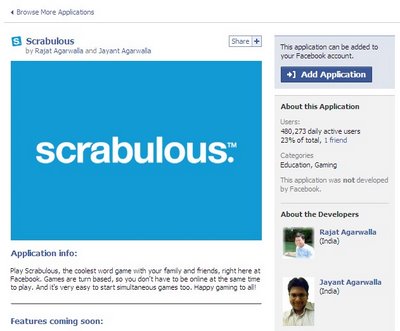
geektacular drama between Scrabulous and Hasbro, mainly to illustrate how the 'net invests people with power over a brand's destiny. By now you know the story: two brothers created the Scrabulous app for Facebook. Scrabulous is a Scrabble clone whose popularity became what I guess could be called "a worldwide phenomenon." The site logged over half a million users per day at its peak.
Hasbro and Mattel, which own global rights to Scrabble, did nothing for
months. Then one day, almost on a whim, they
demanded that the app be removed from the Facebook community.
A cadre of dissidents promptly launched a Facebook group called "Save Scrabulous." Now it's got so much clout that when a user searches "Scrabulous" on Facebook, it's the top result.
Hasbro tried making nice with disgruntled Scrabu-lovers by claiming to "understand [their] passion for the Scrabble brand" -- words that were repeatedly mocked by internet trolls because it's not the
brand users love, it's the damn game, and shouldn't the world's second-largest game maker be able to make that distinction?!
Since its cease-and-desist, Hasbro hasn't won back any Scrabble players. Meanwhile, the Scrabulous creators built another Scrabble clone with a different look and feel (thereby avoiding more legal issues with you-know-who). It's called
Wordscraper and is apparently very popular.
"What did Hasbro do wrong?" Shirky asks, following up with the tactic keynote speakers so love: answering his own question.
Inaction at the beginning! he stressed. If Hasbro had a problem with Scrabulous, it should've said something or released a competitive game, right at outset. Its long silence set the expectation it would just let Scrabulous be.
"Inaction by the company no longer means inaction in the marketplace. It just means other people besides you will do the acting," Shirky preached, a message I found oddly meaningful.
Another thing Hasbro failed to realize: nobody cared about its acknowledgment of their "passion." People weren't looking to have a conversation with
Hasbro; they were looking to converse
with each other. Where Scrabble and Scrabulous were concerned, suddenly
that was the only dialogue that mattered.
Wrapping up, Shirky left us with a statement I considered long afterward. "If you've got more than five customers, someday they'll start talking. And [when that happens,] you might not be invited to the conversation."