Angela Natividad's Live & Uncensored!

Showing posts with label adtech chicago 2008. Show all posts

08 August 2008

Email 3.0: Smiling Into HAL's Eye

eye-of-hal.jpg


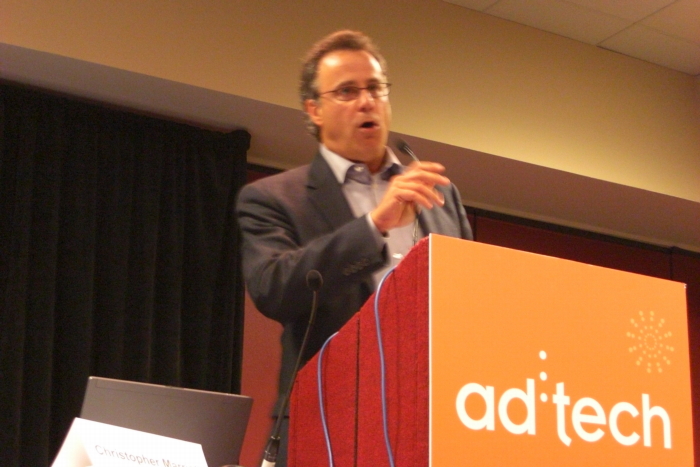
While "The Role of Email in a Web 3.0 World" was mostly theory, I liked its feel-good flow. Moderator Christopher Marriott of Acxiom Digital got panelists comfortable without making viewers feel like they were sitting on the outside of an inside joke. It's a rare and beautiful skill.

Marriott acknowledged it was late in the day and told us up-front that the panelists were debriefed on his questions beforehand. As a result, he said, they came laden with slides to answer three major questions:

1. How might the nature of email change as it goes more completely cross-platform?

2. Can email coexist with the semantic web (web 3.0) ... or co-opt it?

3. What role will The Consumer play in creating web 3.0 email?

Before we get too deep down the rabbit hole, let's define web 3.0.
CIMG3768.JPG


Web 1.0 was pure information-gathering. People used it to answer data- or fact-oriented questions like, "How are the White Sox doing today?"

Web 2.0 wedded information-gathering to collaboration. Today, the 'net answers two questions: "How are the White Sox doing? And what do my friends think about how the White Sox are doing?"

The theory behind Web 3.0 -- the so-called Semantic Web -- is that the 'net won't just be a place for interacting with friends and colleagues. The web itself will interact with you, learning what you want, who you are, and what you are likely to do in the future.

So even before you ask the question, Almighty Internets will turn to you and say, "THIS is how the White Sox are doing. By the way, you've won some cash in the office pool. Oh, and yes, Bob does think you're fat." (Okay, it won't quite be this way. But you get the idea.)

Web 3.0 will know your intent when you interact with it -- a concept Google grapples with as it seeks to evolve beyond contextual advertising, and that wannabe-rivals -- like Powerset and Cuil -- claim to have already mastered.

Hokay. So what does any of this have to do with email?

Email is a relic of the old guard. While web 2.0 is mostly a "pull" agent -- that is, your friends know what you're doing based on what your Facebook status proclaims -- email marketing operates under the traditional "push" model -- i.e., if you want your friends to know what you're up to, you must mass-mail each one of them.

(As an aside, Google's Gmail is helping put email into "pull" mode. Gchat, a chat box inside Gmail, enables users to broadcast status messages, a la Facebook, to email buddies. Of late, I'm using a lot less AIM and a lot more Twitter + Gchat.)

A few facts for the changing face of email:
CIMG3771.JPG


Users under 24 don't use email the way those over 24 do. Teens are more likely to text or hit Facebook than they are to shoot a two-line message through an email client.

But email's not drifting into obsolescence; its perceived role in the user's life is only changing. For me, getting a message across to friends is all about speed and efficiency. I can broadcast one message on Facebook or Twitter and ensure everyone who needs to know about it will get it right away -- increasingly via mobile as smart phone-based apps for FB and Twitter grow more common.

There's a certain formality to email that's lacking in quicker communications. When I shoot an email to a new colleague, I read it carefully in hopes of creating the most favorable impression. And that's a common sentiment: as the "Facebook generation" (users 18-24, 10 percent of the population) invades the workforce, they look at email as a skill crucial to mastering in the career environment.

There's also a benefit to the response delay inherent to email. If my boss -- or hell, a PR person -- texts me with an unsavory (but often necessary) gig, they'll probably think they're being ignored if I don't answer ASAP. But if they send me a message via email? Heeeey. I can mull for awhile, consider my options, provide a thoughtful response after maybe a few hours or -- just between us! -- even wait a day. People don't assume you'll read an email instantly.

And as Lauren McDonald of Silverpop pointed out, email remains a superior medium for certain types of communications. Flight alerts are preferred via email rather than via text-message. And here's some exciting news: as smartphone sales increase (7.3 million sold in North America, 1Q08!), the likelihood of a user being exposed to an email more than once goes up: studies show that over 80 percent of those that read email from mobile devices also read them on PCs.

Unfortunately, current email marketing standards are pretty primitive. This is something that'll have to change as we approach the hype-ridden and glorious Web 3.0. Quoting a JupiterResearch study, Ryan Deutsch of StrongMail said many companies send out radically different streams of email to the same customer.

If Web 2.0's taught us anything, it's that people want to be addressed as individuals, not as your "Dear Valued Customer." Panelists encouraged listeners to explore customers on a ridiculously personal -- slightly stalkerish? -- level: Who's your most frequent buyer? What flowers does she like? Does she have kids? Target her with a consistent message, preferably one tailored to her sensibilities.

But that's 2.0 best practices. Practically the stuff of yesterday. Matt Wise of Q Interactive expanded on the hypothetical role of email in Web 3.0 in a manner most HAL.

At best, email 2.0 uses the past to determine the likelihood of future patronage. This person visited a baby site. Therefore this person is likely to want diapers. Wise calls this method "tremendously wasteful."
CIMG3769.JPG


In 3.0, Wise says, we'll be able to predict future purchasing actions WITHOUT consulting a user's past: They've never been to a baby site, but I predict they'll want diapers based on some kind of algorithm that I can't even wrap my brain around yet.

And while there's little we can do now to divine who'll love us tomorrow, people in the background are already working on making it a possibility. Your emails are being read. Your code is being deciphered. There's facial recognition, heat mapping stuff, going on out there to try targeting advertising to you.

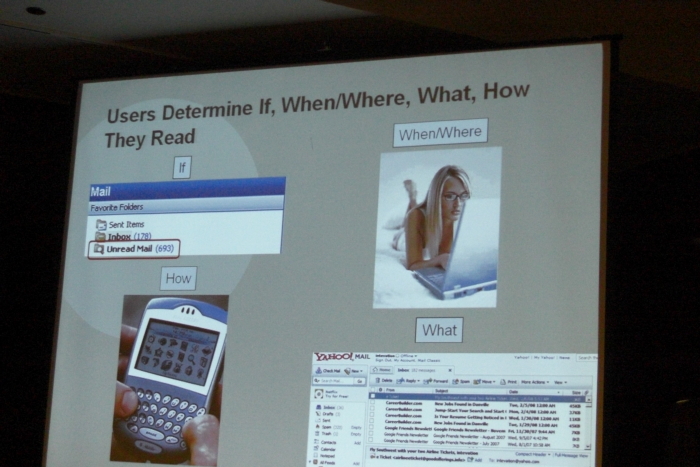
For those anticipating tomorrow's online marketing environment, panelists stressed the following message again and again: when pushing email, think about when a user will receive it, where s/he'll likely read it, and why they'll want to open it.

A simple enough mantra for the bathroom mirror.

At the end of the sesh, a woman who represents a cadre of freelance photographers asked whether it's more valuable for her clients to push their email marketing messages with images or text.

"Use both," McDonald advised. The image is good, but describe it too. The latter will prove particularly helpful if recipients check the email from a phone. Many can't render images yet, but that's changing.

07 August 2008

How Hasbro Lost the Fight for Scrabble's Soul


Tuesday night at ad:tech Chicago wrapped up with a keynote by author Clay Shirky, "Here Comes Every Customer: The Former Audience is Talking Around You."

The Big Idea, if intro speaker Drew Ianni is any authority: "The internet is the most important thing to happen to the human species."

That's a pretty high and mighty manifesto. Upon taking the stage, Shirky tried conveying the same idea with more precision -- and a much higher word count.

"We're living through the greatest expansion in human expressive capability in history," he began. Only four other "expansions" were just as crucial: the printing press, point-to-point communication (telegraph/telephone), recorded media, and harnessing the electromagnetic spectrum (ie., conveying images and sound over the air and into radios and TVs).

There was a vast asymmetry to these models. The media that was good at creating groups, such as TV and radio, couldn't support conversations. And the media that could support conversations (the telephone, par exemple) was bad at creating groups. (Unless you had party line, but Shirky didn't go into that.)

This is what makes the 'net such a dream-snatcher. It is the digital carriage for all previous media: sound, images, moving images and sound. It supports dialogue between many at once, and even introduces a Darwinian element: When a person buys a computer, the internet doesn't just get a new consumer of content; it also gets a producer.

You see? You see?! Those dear tubes have made us both recipient and creator -- a deliciously self-perpetuating duality we can now revel in, like asexual fish.

What's more, conversations that take place on the 'net continue to be relevant, even after they've died. Shirky used the example of a forum thread he found. The thread was months old; its passionate participants had long since wandered off to lob diatribes elsewhere. But because the discussion that brought them together is published online, people like Shirky can still cull useful information from all the opinions, anecdotes and experiences they left behind.

As one of his closing cautionary tales, Shirky rehashed the geektacular drama between Scrabulous and Hasbro, mainly to illustrate how the 'net invests people with power over a brand's destiny. By now you know the story: two brothers created the Scrabulous app for Facebook. Scrabulous is a Scrabble clone whose popularity became what I guess could be called "a worldwide phenomenon." The site logged over half a million users per day at its peak.

Hasbro and Mattel, which own global rights to Scrabble, did nothing for months. Then one day, almost on a whim, they demanded that the app be removed from the Facebook community.

A cadre of dissidents promptly launched a Facebook group called "Save Scrabulous." Now it's got so much clout that when a user searches "Scrabulous" on Facebook, it's the top result.

Hasbro tried making nice with disgruntled Scrabu-lovers by claiming to "understand [their] passion for the Scrabble brand" -- words that were repeatedly mocked by internet trolls because it's not the brand users love, it's the damn game, and shouldn't the world's second-largest game maker be able to make that distinction?!

Since its cease-and-desist, Hasbro hasn't won back any Scrabble players. Meanwhile, the Scrabulous creators built another Scrabble clone with a different look and feel (thereby avoiding more legal issues with you-know-who). It's called Wordscraper and is apparently very popular.

"What did Hasbro do wrong?" Shirky asks, following up with the tactic keynote speakers so love: answering his own question.

Inaction at the beginning! he stressed. If Hasbro had a problem with Scrabulous, it should've said something or released a competitive game, right at outset. Its long silence set the expectation it would just let Scrabulous be.

"Inaction by the company no longer means inaction in the marketplace. It just means other people besides you will do the acting," Shirky preached, a message I found oddly meaningful.

Another thing Hasbro failed to realize: nobody cared about its acknowledgment of their "passion." People weren't looking to have a conversation with Hasbro; they were looking to converse with each other. Where Scrabble and Scrabulous were concerned, suddenly that was the only dialogue that mattered.

Wrapping up, Shirky left us with a statement I considered long afterward. "If you've got more than five customers, someday they'll start talking. And [when that happens,] you might not be invited to the conversation."

06 August 2008

The Hunting of the Snark: Finding Value in Online Video Advertising

socrates-club-2.jpg


There are three types of ad:tech session:

  • Roundtables, which look like opportunities for Socratic discussion but are actually ideal hostage scenarios for greedy salesmen.

  • Polite affairs where a moderator, charged with exploring a given topic, poses questions in hopes of getting cotton-mouthed executives to divulge things they're not supposed to.

  • The kind where a moderator -- contemptible creature -- invites panelists to pitch the audience one by one, and the topic be damned!


"The State of Online Video: Going Beyond the Pre-Roll" was the third type.

Things kick off with Josh Chasin of comScore mumbling figures into the mic, followed by Smith Forte of Current.TV. Then Rebecca Paoletti, director of video strategy at Yahoo, takes the stage.

Yahoo has two primary video ad methods:

1. Advertisers provide TV creative, which is immediately converted into a video ad. When a user mouses over it, he has the option of interacting with it in some way or visiting the website. The method is favored because it is simple and easy to execute on a whim.

2. Yahoo creates interactive (rich media) units for advertisers. "Anything you can do in a microsite you can do in the four corners of a video player," Paoletti explained. This model only comprises 10 percent of Yahoo's video ad revenue; the company looks at it as a "next step" and is pursuing ways to get clients more interested in "engagement metrics" (as opposed to gauging the quality of a campaign purely by click-through to a website).

"These are the basics -- what we sell day in and day out," says Paoletti.

But there's a wildcard in the mix: advertisers that want to be producers; that is, content contributors. To illustrate how Yahoo serves their needs, Paoletti shows us the homepage for Yahoo Sports Minute, sponsored by Dunkin' Donuts. See it for yourself: sports content shares slightly less-than-equal space with Dunkin' leaderboards, embedded TV spots and widgets.

Does this make Dunkin' Donuts a content producer? Because the method looks suspiciously like a page takeover. I doubt anyone would visit Sports Minute specifically to see Rachel Ray's controversial Dunkin' Donuts scarf spot.

I raise my hand.

"I don't understand the difference between the 'content producer' and the standard 'video advertising' model." Nobody would ever confuse Dunkin's presence on Sports Minute for content; they'd just perceive it as an overzealous ad buy.

"Good question," Paoletti begins. A pregnant pause develops before she explains that Yahoo also helps with amateur video-style deployments on video.yahoo.com -- think Ray Ban's "Guy Catches Sunglasses with Face" by Feed Company -- "but that's not something I wanted to get into today."

At that point, moderator Josh Chasin of comScore interjects to say he has questions for his fellow panelists, but would hate to take away from audience Q/A time. "How many of you plan to ask questions at the end of this?" he asks (and with a straight face!).

Tentative hands flutter up. Three panelists haven't even spoken yet; how can we know whether we'll have questions?

Chasin's burst of inquisitiveness yields one clear benefit: the evil plot to make us sit through elevator pitches gets totally derailed. For the next now-to-whenever, the panelists talk shop. It's nice to see them get on so well at the expense of everyone else's time.

A few scraps tossed out at random:

"There has to be a way to get beyond counting clicks, otherwise publishers won't get credit for their buying influence" over the long-term, says Simon Assaad of Heavy Corp.

Paoletti: there is no average CPM for video across the board, because any number of variables can change the cost of a buy. Video "needs to work, but just doesn't work" as a dependable ROI model.

Paoletti also says the future of digital video is mobile. Assaad, a contrarian at heart, confesses, "I'm actually not interested in mobile" and lamented embedded video was never really explored as an ROI platform.

"75-80 percent of video consumption online is not being taken advantage of by advertisers!" he says with feeling.

He goes on to say the recession drove advertisers into the arms of ad networks, whose company "would have made our skin crawl a few months ago."

Chasin wonders if there's a place for long-form video online. Forte points out Hulu's click-thrus for streaming shows is great. Plus, it doesn't cannibalize network TV. "This is catch-up viewing. It's a new industry," he beams.

Allen readily agreed, followed by Paoletti. Forte said short-form video isn't very good for ad click-thru because attention spans are shorter.

From a user perspective, I think pre- and post-roll ads should be confined to professional videos. People accept that a reasonable amount of advertising is a fair exchange for content that cost money to produce and is being provided at no cost. Nobody makes mental allowances for ads in amateur work.

I ask whether there's a practical benefit to putting amateur-style videos on YouTube. Forte calls them "mood setters" that help position the brand's vibe. No more, no less.

Chasin turns to the audience and asks if there are anymore questions. A random audience member quips, "Can we hold you hostage?"

05 August 2008

No Undies Today. What's a Girl to Do.

Lots of flight cancellations en route to Chicago yesterday because of a big-ass lightning storm. I was supposed to arrive at O'Hare around 6:45pm, but my flight got tossed and I was put on an 8:40 flight out of Philadelphia which was delayed, then delayed, then delayed. We finally made it to Chicago around midnight.

My luggage is lost.

Arrived at Red Roof Inn near 2am. The concierge was nice. Flight delayed? he said. Yes, I said. I asked for toiletries -- toothbrush, shampoo -- and he said he didn't have any because the lobby was flooded with water in the afternoon. Failing to see the logic there.

Went upstairs to wash face. Facial soap was already open. Decided to just lay down and die, but couldn't sleep. It is now morning, late morning at that, and I smell like airport man musk.

Online encouragement from well-meaning friends (plus boyfriend):

John Engler - "Sorry about your baggage. I made dinner plans tonight. Try to shower."

Steve Hall - "I have man shower stuff if you want to use it."

Benj - "HORROR STORY. Read the comments! Doesn't look good."

David Griner - "Now pull yourself together, woman. Sexy blogging is about opportunity, and you're missing out. You should be posting tweets about 'no undies today, what's a girl to do,' etc. Don't make me send you back to Big Dave's Finishing School."